


“The next day Moses entered the tent and saw that Aaron’s staff, which represented the tribe of Levi, had not only sprouted but had budded, blossomed and produced almonds.”
Old Testament, Numbers 17:8
Flying back from Newcastle this week with a colleague, we headed for the bar at the airport.
The restorative Rioja I was drinking was a bit acidic. I needed some food, and my kind colleague found me some almonds.
Almonds are a sort of wonder food – I nibble, guiltless, at them all the time. Guiltless because I am supposed to worry about cholesterol and almonds contain cholesterol-lowering monounsaturated fats.
Guiltless also because in the early evening my blood sugar plummets and I get the munchies – almonds have a high protein content so they help to balance the yo-yoing sugar levels much more effectively than a biscuit binge would. Almonds (as well as pork shoulder, chicken, mackerel and lentils) contain key amino acids which, within 30 seconds of touching the tongue, activate appetite-regulating brain cells called tanycytes – so they are doubly helpful in controlling food cravings.
They’re also rich in Vitamin E which is supposed to stave off Alzheimer’s…here’s hoping…
In any case I think they taste good.
My initial regret was that we hadn’t been able to find some Marcona almonds – these, together with a cold, dry, nutty en rama Spanish sherry, would have wafted both of us far away from wet and windy Newcastle, and back into a whitewashed Andalucian pueblo.
The Marcona almond is sometimes referred to as the queen of almonds, and it must be one of the best varieties. It’s grown mostly in Spain, particularly the area around Malaga, and it’s fatter, softer, and with a more delicate and sweet taste than ordinary almonds. It’s particularly good for baking.

The Spanish put them into their turrón; they put them into a rollickingly good romesco sauce; they add them to salads; they eat them with manchego cheese; and they fry them in olive oil and combine them with a whole host of things and eat them as a tapas. Most successfully, they use them to make ajoblanco – a cold garlic and almond soup.
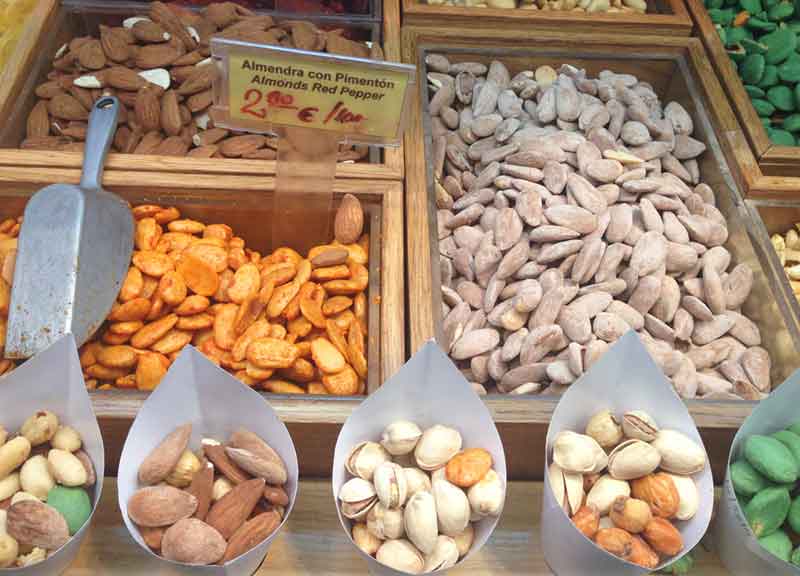
At the Mercado de San Miguel in Madrid there was a stall dedicated to nuts which majored on different flavoured Marcona almonds, as well as selling ‘normal’ almonds – you can see it in the featured image at the top of this post.
Marcona almonds aren’t always the best choice. In the end, the hard-roasted, robustly salted ‘normal’ almonds were just what was needed to combat the inclement weather in Newcastle as well as our hunger and exhaustion.
Things to do with Marcona almonds:
The savoury
- you can dry fry them (go here to find out why this is such a good treatment for nuts), and then add a little olive oil and sprinkle with some good quality salt – the Icelandic Norður is wonderful.
- you can do the above and add a little rosemary to the dry frying pan.
- or you can add a little chilli or berbere.
- or, as Sally Clarke suggests, you can use them in a wonderful salad of apricots, watercress and mozzarella with a balsamic vinegar and chive dressing.
- at Brindisa in South Kensington they serve Marcona almonds with sprouting broccoli and wild garlic as a tapas
- they are great with Spanish cheese, especially Manchego (or try some British cheeses which are of a similar style)
- make ajoblanco soup
and the sweet
- or you can go down the sweet approach – an idea from Jamie Oliver – rinse, roll in icing sugar, roast until golden and use to top all kinds of puddings and ice creams.
- or alternatively eat with dark chocolate
- or with Spanish hot chocolate
For a post on sherry, follow this link.
To read about The British Challenge To Manchego, follow this link.
This post is dedicated to Lorraine Darling.
